Lehman College, CUNY

BRONX, NY – Dr. Christy Folsom is an associate professor in the Childhood Education Department of Lehman College, City University of New York.   Her academic focus is on the intellectual and emotional infrastructure of teaching and learning, project-based learning that includes self-organization skill, transfer of learning from coursework to P-12 classrooms, and change in teacher thinking and practice evidenced in student performance. In addition, she developed Teaching for Intellectual and Emotional Learning (TIEL), a powerful curriculum planning tool for teachers.

While planning her undergraduate course entitled “The Art and Science of Learning and Teaching”, Dr. Folsom contacted the JW Foundation with an interest in participating in our book donation program.  “In this course, we will explore scientific aspects of how we learn as well as how learning can be an art.  Understanding learning as a science and as an art can have a profound impact on how we teach,” Folsom explains.  She plans to use examples from The Art of Learning and Resilience based principles such as Value Process Before Results, Investment in Loss, Beginner’s Mind, and Using Adversity to illustrate the importance of teaching for intellectual learning in conjunction with emotional learning.

“How do you learn something and stick with it long enough to master it?” Dr. Folsom asks.  “Yes, Josh had a gift for chess, but with tai chi it seems that he had to work so much more.”  She believes Josh’s learning journey is a wonderful illustration of the wide range of learning, both social/emotional and cognitive/intellectual, and the necessity for struggle that must be addressed in the classroom in order to provide students with the complex learning experiences they need to succeed in the twenty-first century.

Loving the Game of Making Music

By NIKOLA TOŠIC

There is a powerful memory, which always resurfaces when I am helping people make music. It is of my brother, my sister and myself, ages 7, 6 and 5, digging through a crate of Legos, working on whatever it is our minds were determined to build. In that serene setting we found ourselves making something a little less touchable.. It would be a wonderful, completely spontaneous and improvised song, comprised of tongue clicks, whoops, tiki-tikis, nhya-nhye-nhyes and a whole array of sounds from our imaginary languages. It was a sort of trance-like ritual of our little tribe and I can never tell how long this composition lasted. It was so enchanting that we had a hard time bringing it to an end. We laughed so hard as each tried to put a silly punctuation to it.

I’ve seen this exhilarating creativity many times, not only in children, but in grown-ups as well. And I mean solemn grown-ups, dealing with adversities, all of which seem to crumble away while making music, as if they stepped through a portal to their childhood curiosity and excitement. As a musician and a workshop facilitator, the principle Loving the Game resonates with me in a powerful way.

In my experiences with music education, I’ve had difficulty reconciling with the dryness of the learning process. Through all of it, I’ve come to believe that learners relate best to the great composers and their work if they themselves are encouraged to be artists.

What I do is guide groups to make their own music. The groups vary in age and musical experiences. My task is to guide them out of their sphere of knowledge, into an open place where it’s safe to “not know”. Here there is room for abstract thought, for silliness, for darkness, for music they are not required to analyze, label or explain.

A crucial aspect of the process is the absence of written music. The workshop is an aural experience, which creates a powerful connection to the artwork and to the other artists.

One approach is by starting off the process with abstract content that is within their grasp, like rhythms using assigned numbers per some visual parameters, introducing color coded groups of notes, discussing topics from other areas etc.

After the introduction of the abstract, the participants split up into smaller groups and are left with a somewhat open task. Their minds can now tinker with the material they’ve been introduced to. They are then discovering other building blocks of music and seeing how they work alone or together, then inverted, reversed, stretched out, squeezed, mangled etc.

While they are working on their pieces, my role is to ask questions, offer different points of view and carefully nudge them if needed. This is often the time to encourage them to follow through with some ‘crazy’ impulse, if they were having second thoughts. As they swing between the open, explorative realm and everyday social habits and fears, validation can give them a much needed boost to take their composition further than they might have thought possible.

It’s important to emphasize the uniqueness of each artist and help them understand there aren’t any bad ideas, though some work better with others. Much like my, siblings each of us contributing a layer to the chant, it can be magical when these unique voices/ideas find their way to fit together.

As the music makers enter this open space, a natural process has been activated. Now there is a sense of camaraderie among the group, people are supporting each other, teaching each other little bits of music, combining, trying out, changing and improving. Honestly, sometimes it’s mind-blowing how fast things can move in the open space.

It’s easy (and valuable) to get lost for a while in the endless ocean of musical possibilities. There might be a moment a group needs someone to “translate” their open ideas into clear tasks. I find short time constraints to be a wonderful challenge, especially now that the group is working together against the clock.
One of the most beautiful results of the creative process is the focus on quality and intention. Most of the time, it comes completely naturally, as the artists assume ‘ownership’ of their compositions. It’s a powerful thing to observe and the intensity of a performance is hard to describe. It can even be too intense, as I’ve gotten into serious trouble with some fourth graders when my phone went off during a recording of their piece.

There is a tremendous source of energy to be found in Loving the Game. I believe this to be a sustainable energy, which can keep the creative mind returning to the timeless realm, where presence and selflessness bring beautiful art into existence. Moreover, when the music making is a shared experience, it opens up a whole world of connections between the artists.

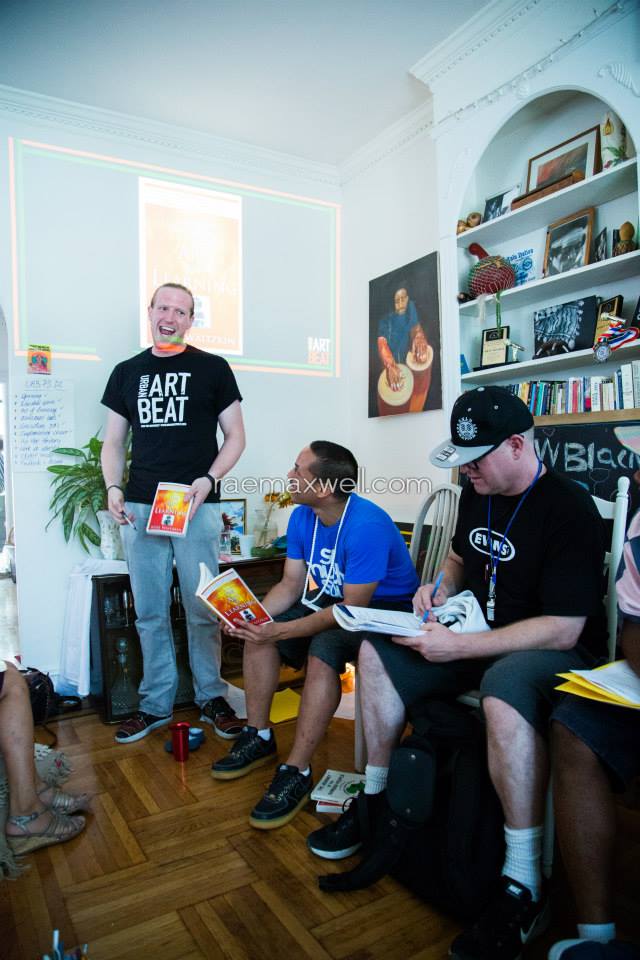
Urban Art Beat

NEW YORK, NY – Urban Art Beat is a platform for creative expression, partnering talented artists and dedicated volunteers with under-served schools and organizations in New York City and around the world.  They believe that creative expression through the arts has the potential to enhance the mind, spirit, and artistic energy of youth and engage them in shaping a vision for their community’s future.  They empower youth, fight educational injustice, and reduce dropout rates by creating reliable partnerships and innovative projects through Hip Hop culture and arts education.

Jake Rich, UAB’s Assistant Director, approached the JW Foundation with an interest in bringing The Art of Learning principles to both the teaching artists within his program and the students with whom they work.

“Proper form is a crucial foundation for achieving success in any discipline, and learning how to learn can make everything a person does more efficient and effective,” Rich explains.  “I wish I had the opportunity to read The Art of Learning as a teenager and now I’m thrilled to be able to teach the principles to creative young people in NYC.  I’m confident our partnership with the JWF will be invaluable in guiding our students and teaching artists alike towards reaching our full potential.”

Photo credit: Rae Maxwell

All Urban Art Beat teaching artists read The Art of Learning and participated in discussions and presentations on the content during their summer Professional Development retreat. With a focus on creating a common language and model for teaching, the retreat provided a platform from which teaching artists could plan for how to incorporate The Art of Learning principles into their work with students over the course of the school year.

In the coming semester, the teaching artists will discuss chapters of the book in their monthly meetings and work with some of the ideas outlined in the teacher, student, and parent companion guides.


Early College of Forsyth

WINSTON SALEM, NC – The Early College of Forsyth is a small public high school located on the campus of the Forsyth Technical Community College. They offer a unique program in which students begin taking college courses in their freshman year alongside their high school coursework. After four years, they are able to graduate with both a high school diploma and an associate’s degree.

Diane Morrow has been an English teacher at ECF for 6 years, and uses her considerable experience to help her students become critical thinkers around the concepts of education and learning.  She plans to work with a small subgroup of students in her Junior English class to explore the themes and learning concepts outlined in The Art of Learning. “I’m especially interested in using the book to help students learn to deal with resistance and obstacles and to get them thinking in new ways about learning and what is possible,” Morrow explains.

She will offer a reading journal assignment where students choose quotes from the book and respond by making connections to their own experiences. In addition, students will have a choice of projects, including creating a video, a speech, and/or an interactive learning experience for their classmates that introduces their classmates to one or more key concepts from the book and how it can be applied to learning. The goal is to encourage them to use the book to think about their learning both within and outside of school.


Making Smaller Circles with Visual Design

By ALAN DOMIC

Visual design is a field drastically under-supplied with good learning resources. This could be of absolutely no relevance to you, but it was crucial to me when I started trying to learn it systematically. In that attempt, I came across The Art of Learning and gradually got much better at learning; along the way, I picked up some lessons that may turn out to have relevance for you. Writing about them all would fill a booklet, so in this article I’ll only give you some thoughts on the principle from The Art of Learning that has been the most consistently helpful to me at every level – Making smaller circles.

My initial use of Making smaller circles was for learning the macro from the micro. In my case, that meant designing the least complex element that requires the same kind of choices as a full-scale work (such as a printed page or webpage, for example). Using web design as an example, the humble webpage button is a good choice for this, since designing one entails decisions about typography (the design of text), color and layout; for the same reasons, a paragraph with a title works well. After designing many iterations of those basic elements, I was surprised how considerably my grasp of the fundamental principles was strengthened: earlier, I thought these elements would be too trivial to focus on. But I found that my workflow sped up greatly and a slowness I hadn’t even been aware of had disappeared – as if I’d been wading through molasses and suddenly broke free. I found the takeaway for learning abundantly clear: there is no “too trivial” element of the whole to focus on.

After many exercises involving just one element, I moved on to small-scale pieces consisting of a few elements, as a way of probing the understanding of my principles in a controlled environment. While doing these exercises, Tim Ferriss’ thought from The 4-Hour Chef that “the burden on working memory is what makes something easy or hard” kept popping into my head. It seemed absolutely true to me the first time I’d read it – but now I felt I understood it on a visceral level. A better understanding of fundamental principles also led me to appreciate design in a new way: a beautiful design now seemed to be simply one whose elements are in harmony. This isn’t a new idea, but I couldn’t appreciate it viscerally or experience it influencing my work before I’d refined my understanding of the key principles to a finer level. I should note that grasping what “being in harmony” means for any group of elements is arguably the stuff of being a great designer – it wasn’t that I achieved this, but I found the mark to aim at.

I eventually realized that this approach made me better attuned to the interplay of various elements. In many cases, a good design has a fractal-like quality: its parts mirror the whole. I now regularly work “from the inside out”, planning a piece not from its frame or the most visually dominant feature, but from the element that “carries most of the load” of conveying the message. This is analogous to planning a story from the most important element (the one carrying most of the narrative load) outward – which could be the characters, the setting, or the story arc, or some other element. Why this approach? Because I find the characteristics of this element determine most of the other relationships between elements, and these are what makes up the entire work. In many cases, these relationships mirror those within the main element – and those of the main element with secondary elements may mirror those between elements further out, and so on. This is how the work gets the fractal-like quality I spoke about earlier. In this way, using Making smaller circles for learning was a stepping stone for using it to learn about the structure of a full work. Broad usefulness of this kind, at any degree of proficiency, is the reason I’ve found this principle so universally helpful.

Bear Valley Middle School

ESCONDIDO, CA – Raymundo Rodriguez teaches the 6th through 8th grade Bear Academy advisory class in this public middle school.  He approached the JW Foundation through our book donation program with an interest in developing a program to motivate and inspire underperforming students who struggle with behavior and academic issues in school.  He plans to begin the school year by having his students read and discuss The Art of Learning in order to “make a connection with the students.”  Rodriguez says he wants to “allow them to read about learning and become owners of their choices and outcomes.  I want to help my students become life long learners.”