NYU Wrestling

NEW YORK, NY – Gene Kobilansky, the assistant wrestling coach at New York University, has implemented an Art of Learning based mindset-training curriculum with his athletes with an aim to develop resilience and an incremental approach to wrestling and learning in general. “Our goal is to instill a love of learning and a focus on intrinsic goals and growth in our athletes. I believe if they focus less on winning the next match and more on loving the process, they’ll see higher levels of success,” explains Coach Kobilansky.

He is beginning his program with an exploration of what motivates people in their pursuit of mastery with assignments that focus on the idea of purpose, autonomy, incremental mindset, and resilience. He plans to continue this work with a focus on Investment in Loss and a depth over breadth approach to overcoming challenges and improving technical skills.

Blaine High School – Center for Engineering, Mathematics, and Science

BLAINE, MN – Jon Loo, an English teacher at Blaine High School and varsity hockey and lacrosse coach, developed a grade-wide study of The Art of Learning for the 10th grade English students. With a strong focus on engineering, math, and science, the educators at this school are devoted to developing and implementing a curriculum in grades 9-12 that will challenge students in all curricular areas.

The 10th grade English students read The Art of Learning during their non-fiction literature study following a fiction study of Zen and the Art of Motorcycle Maintenance.

“We think that The Art of Learning is an ideal follow up to continue reinforcing the distinctions between classical and romantic, or integral and entity based paradigms,” explained Loo. “The thought processes and learning processes that Josh outlines as his secret to success are in concert with the path to the best engineering, mathematical and scientific accomplishments. The students will love Josh’s real-life story, appreciate his perseverance, and learn from his method.“

After reading the first two chapters of the book, the students began to discuss its relevance to the study of English. “When Josh discusses the ability to learn in multiple disciplines by immersing in one task, I think he’s tapping into the power of metaphor, which of course is the gateway to the study of language. Making connections between disciplines, benefiting on an unconscious level for a deeply singular conscious activity, studying the numbers to leave the numbers, these are the realizations that we discussed hoping to achieve,” Loo explained.

The culminating project in this unit of study was for the students to write and produce video documentaries of fictitious inventors who succeed because they work incrementally in the process of engineering something useful. “The creation of the documentary will give the students some video story telling skills while reinforcing the values and principles great scientists and engineers follow to achieve excellence in their fields.”

You can view the student films “Lighting the Way” and “The Cure for Brain Cancer” here or on our Educator Resources page.

Fundacao Universidade Regional de Blumenau

BLUMANU, SANTA CATARINA, BRAZIL – The mission of Fundação Universidade Regional de Blumenau is to promote teaching, research and extension, sustainable socio-economic development, and social well-being. Natan Lotério, a student at the university, along with one teacher and five other students from the Computer Science department, have formed a study group interested in exploring a variety of learning techniques. “For a long time I have wasted opportunities to help others and myself, “ Lotério explains. “Now I want to catch up and have a great plan for helping people. I want to help them better understand how they think, understand, and see the world. I believe in the power of learning. I believe that just teaching ourselves how to think and learn, we will evolve into a more intelligent society.”

Lotério and the other members of his group will read The Art of Learning together and discuss the learning principles. From there, they plan to identify a learning module to explore further as a means of deepening their understanding of the learning process.

University High School of Science and Engineering

HARTFORD, CT – University High School of Science and Engineering, in partnership with the University of Hartford, is a magnet school that focuses on academic excellence and early transition to higher education, while developing responsible citizens who demonstrate healthy integration in a diverse society.

Caryn Baseler, the Instructional Coach, has organized a yearlong Professional Learning Community centered on The Art of Learning. The teachers, counselors, and administrators at the school will meet on a monthly basis to read and discuss the book with a goal of collaboration across grade levels and curricular areas. “Many of our students are very gifted and we are challenged to find ways for them to grow to their full potential within our classrooms. Often, these same bright students are very needy and fear being wrong. We would like to help them develop the understanding that being wrong is okay and can lead to greater understanding,” explains Baseler. “We hope to gain insight from The Art of Learning to help us as we continue to strive to reach every student.”

Tanenbaum CHAT

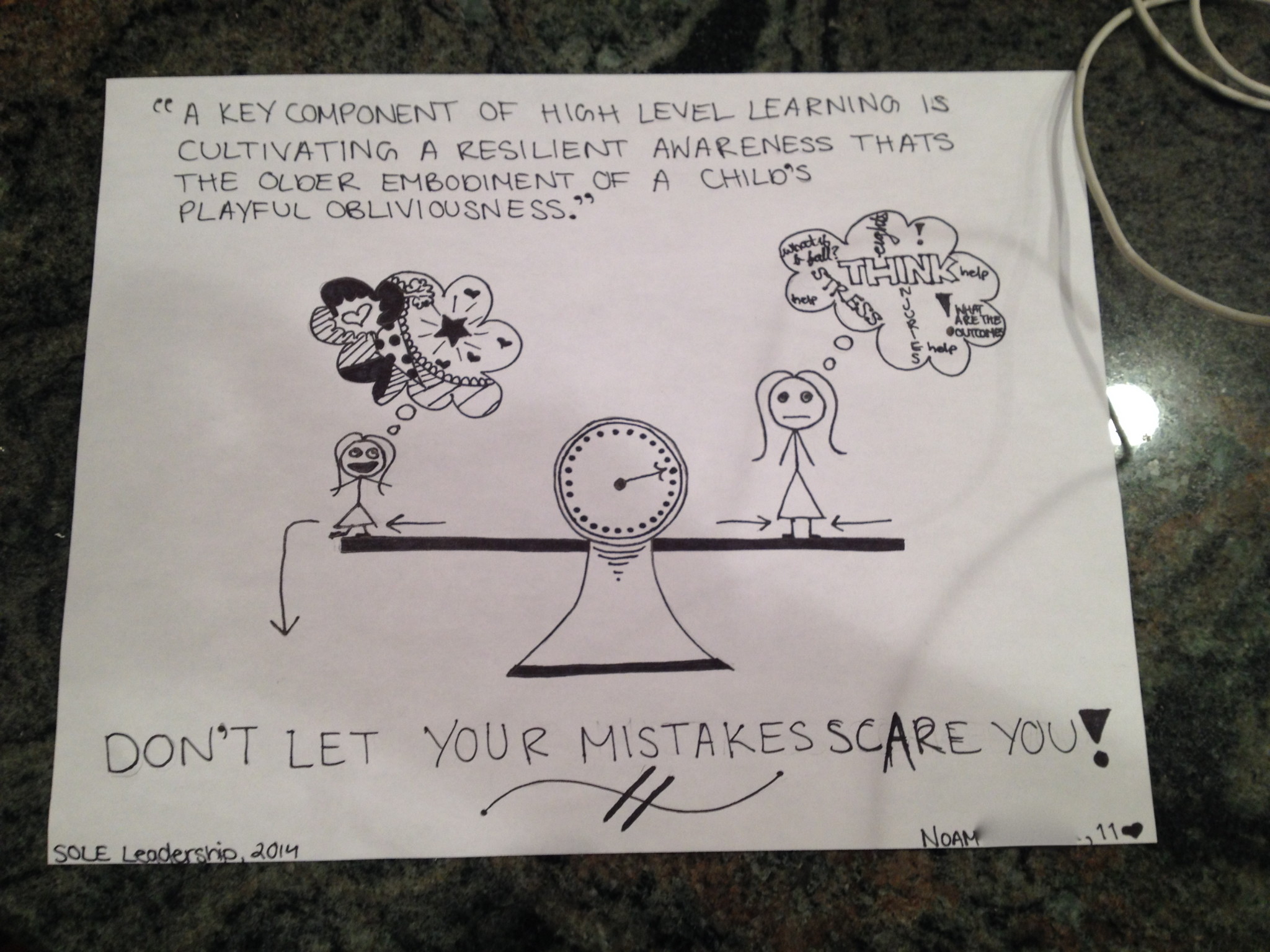
MAPLE, ONTARIO, CANADA – Jamie Cohen is a 9th grade English teacher and Director of Student Extra-Curricular Activities at Tanenbaum CHAT (Community Hebrew Academy of Toronto).  This year he ran his second SOLE (Self Organized Learning Environment) Student Leadership Seminar for 115 students ranging from 13-17 years of age, all of whom are in some way involved in creating, organizing, and running extra-curricular events and activities.  He is interested in “spurring teenagers on through adversity to creative, new angles in the planning process of events, how to be clearheaded, present and cool under fire in the week leading up to an event and the event itself” and, overall, to learn how to become exceptional leaders. He used W2M (Willing to Make Mistakes) Inspiration Boards to explore Investment in Loss and Using Adversity with this highly competitive group of students, with an aim to help them shift their perspectives “when looking at mistakes, obstacles, and resistance points during the adventure of creating extra-curricular school projects.”  They also used the learning principles to create a plan for their commitments and activities throughout the year, learn to prioritize goals based on those commitments, and become more cognizant of where they focus their energies.  Self-assessment will be included in the process and there will be a follow up meeting to help keep the students focused on their commitments.  Mr. Cohen has shared the complete assignment for the seminar, as well as a few of the students’ written and visual responses on our Resources for Educators page.

In addition to his work with the SOLE seminar, Mr. Cohen developed an Art of Learning program in his 9th grade English class as part of a 6-week novel study unit.  The students used The Art of Learning in conjunction with their study of the novel, The Curious Incident of the Dog in the Night-Time.  As a culmination to this unit, the students applied their knowledge of one of the main themes: empathy comes through investigating, seeing, hearing and feeling the world from different perspectives through the creation of a Curious Empathy Board that integrates the “play between knowledge, intuition, and creativity.”  The Empathy Boards included both visual and verbal components and encouraged students to focus on ideas from The Art of Learning such as Numbers to Leave Numbers and Breaking Down Walls. Mr. Cohen has shared the complete assignment for the empathy board as well as some of the students visual and written responses on our Resources for Educators page.

Maumee High School

MAUMEE, OH – Christopher West is a teacher in the science department and the men’s assistant varsity soccer coach at Maumee High School. He plans to use The Art of Learning in his 11th and 12th grade Introduction to Critical Thinking Class to develop the students’ understanding of how they learn and to encourage introspection.

West explains, “The mission of my class is to guide students into critical analysis of every area of their lives.  This class takes the focus away from tests and into active examination of the students’ own understanding.  We explore how worldviews, cognitive dissonance, confirmation bias, fallacies, and values effect their evaluation of arguments. The end goal being an understanding of the students’ own learning that is engaged, purposeful, and cross-curricular.”

West believes that introducing the students to learning principles such as Numbers to Leave Numbers will push his students toward a deeper understanding of how learning takes place. “By seeing how Josh used these concepts to become a champion at chess and martial arts,” he explains, “the class could then ask themselves the question ‘How can I use these concepts in my own life?’ That applicability is key. Taking classroom lessons outside and into the world should really be the goal for all educators.”