
The Art of Bowling

By JOHN KAFALASKafalas

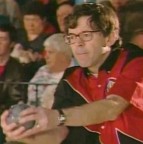
I’m a candlepin bowler, on an unusual career path: I was very active as a youth bowler, then drifted away from the sport after high school and bowled only sporadically for most of my adult life, until I decided, at the age of 43, to return to bowling as an intensive competitor and see how much I could accomplish at this stage of life.  At 50, I’m bowling better than ever before – and much of the credit has to go to the principles detailed in Josh’s book.

The first two chapters, Innocent Moves and Losing to Win, speak to my experiences with instructors, my   approach to learning, and the way I handle adversity in competitive situations.

CHAPTER 1: INNOCENT MOVES

My bowling coach has a saying that identifies him as an incremental learning theorist: “You’ll get almost as good as you want to!”  I love that, because it means there’s no limit to how much you can improve, if you just keep raising the bar.  That’s what he does for me, when I see him for a lesson. He has a higher opinion of me than I have of myself, and he totally embraces the incremental theory of learning. This helps me to understand that I can get better and better, even at 50, if I want it badly enough to put in the work.

One of the questions in the Study Guide to TAOL asks, “Do you think you are emotionally prepared for both wins and losses?”

I often get my best results when I come into a tournament feeling a little bit tired or sick, possibly because my low expectations on those occasions make it easier to just be present and throw the ball.  But I’m not sure that I’m emotionally prepared for wins and losses. When I lose, I always try to come away with some knowledge that will help me next time – but this does not always happen.  Sometimes I’m not prepared for a win, either.  Several years ago, when I won a pro candlepin doubles tournament, I was so stunned afterwards that everything was a blur – I got in my car and drove about 20 miles in the wrong direction before I realized my mistake!  I have trouble believing that I’m good enough to compete with the best bowlers – I’m not sure why.  Even after winning a professional tournament, I still lacked (and lack) self-confidence and sometimes feel that I don’t belong, against the best bowlers.  This is part of what I’m trying to explore with Josh’s book.

CHAPTER 2: LOSING TO WIN

In this chapter, one of the most important concepts is what Josh calls “commitment beyond fun – responding to heartbreak with hard work.”

When I’m discouraged after a bad tournament, what I try to do is to be patient.  I remind myself that as long as there’s a “takeaway” from every event, I haven’t wasted my time.

It’s not that winning isn’t important, but generally, my best takeaways are from losses.  Every spring, I compete in the Easter Classic, a 20-game candlepin tournament that takes all day and uses up pretty much all of my energy, both physical and emotional.  Last year, after around 13 or 14 games, I was extremely tired and sore – and was also not bowling very well, so I knew I wasn’t going to take home any money.  I was so fatigued and sore that I considered withdrawing from the tournament. But I thought, “What would Josh want me to do right now?”  The answer was simple – stay in the game, be present, keep grinding, and find a way to make the rest of the tournament a learning experience for the future.  So I got away from the lanes for a few minutes, washed my face, walked around a bit, and refocused on staying patient and trying to find a way to bowl well despite the fatigue and pain.

My right arm and shoulder were so stiff that I couldn’t swing the ball as high as I normally do in my backswing – but I figured out how to make it work and turned the last five games into my best five-game block of the tournament.  What’s more, I have retained the slightly lower backswing and find that it gives me more accuracy and consistency – as a result, this season has been my most successful ever, at the age of 50.  This is how Losing to Win works for me.

In the Easter Classic – or any pro tournament – there’s always a group of bowlers who throw in the towel when they reach the point where they’re out of the money. The quitters are protecting themselves from the pain that comes from giving your best and having it not be good enough. They’ll say, “I can’t get a break,” or worse, “I stink.”  They won’t be patient, because they don’t want to risk giving 100 percent all day and still having no reward.  Or they say “This isn’t important, who cares.” They’re not willing to invest in loss – and they’re denying that losing hurts.

My approach is to put my emotional self on the line and admit that losing hurts.  Josh describes chess parents who tell their kids that a loss doesn’t matter.  Well, it does matter.  Owning the emotional pain is an important part of learning from it.  And if I’d said, “Who cares?” at the Easter Classic, I wouldn’t have found the swing change that led directly to improved results this season.

Mount Holyoke College

SOUTH HADLEY, MA:  Courtney Caminiti is a student at Mount Holyoke College, where she runs a sciences and tutoring program aimed at mentoring women.  She used The Art of Learning in a presentation on metacognition that she gave to a class which accompanies the tutoring program.  Courtney was a student at Mendham High School when they were piloting their Art of Learning program in the International Baccalaureate Theory of Knowledge course.  She says, “I’m interested in neuroscience, so the book is actually interesting in a whole new way to me after having left high school, but definitely remains relevant to the learning process at all levels”.

Oberlin College

OBERLIN, OH: Costantine Ananiadis is a former D-I tennis athlete, tennis coach, martial artist, and chess player and coach. He has used The Art of Learning concepts in his teaching and his own competition. At his suggestion The Art of Learning was the topic of conversation for the book club in the athletics dept at Oberlin College. He also has all his tennis players read it.

Coach Ananiadis says, “I use Josh’s principles daily in my practice plans for my team and in my long-term mapping for our team’s improvement and skill development as well. It works wonderfully for both. As a former high level tennis player, and as I currently strive to reach master level in my “chess career”, I find that these principles are very practical and therefore easily incorporated into anyone’s developmental plan. I find myself re-reading the book over & over and learning/discovering new things (or rather understanding it at a deeper level) each time.”

Ponguinguiola A.C.

SONORA AND BAJA, MEXICO – Ponguinguiola A.C. is a community organization dedicated to working with public and private schools and low income communities in Sonora and Baja, Mexico.  They work within the community to promote healthy and ecologically responsible lifestyles and to motivate children to develop a love of learning and reach their full potential in life.  Monica Robinson Bours, the organization’s founder, says “We have different workshops for children such as reading and art in our own library and in the schools and communities we have reading and environmental programs.  We always try to approach them so children really love them, engage and participate.”  In addition to making copies of The Art of Learning available to parents and teachers in their library, Ponguinguiola’s program director and educators have read the book and are applying the principles in their workshops with children.

One exciting program in Baja, which takes place over the course of a year, has children between the ages of 4 and 9 learning about the Resilience based principles through an exploration of the trees, insects, and animals that live in their environment.  They learn about the concept Value Process Before Results by adopting a local tree and exploring the value in each stage of the tree’s development (leaf growth, flowers, fruit, dormancy) toward its ultimate goal of reproducing.  They will then explore Investment in Loss with their trees by examining how losses (such as fallen leaves in Autumn or dying flowers) allow for future growth and adaptability.  Lastly, the children spend several days a week participating in a program called “Learning About Myself” which employs Using Adversity to teach them to explore, identify, and discuss their inner, emotional states. Through this program they are beginning to develop mindfulness and early meditation skills.

Guilford High School

ROCKFORD, IL – Erik Czerwin, an English Language Arts teacher and chess coach at Guilford High School, is using The Art of Learning in a book club with the students on his chess team.  As the program progresses, he plans to have the students who have already read the book and experienced the “lit circle” become the leaders next year.  He says, “The idea is to take students after several months of learning about chess, specifically, and encourage them to continue learning and grow their passion for learning.  As they become leaders of the small groups, they can grow as teachers as well.”

In addition, Erik hopes to lead a faculty book workshop in his school using the book.  “The Art of Learning made me a better teacher, and I hope to share that experience with other teachers on staff by creating a Professional Development opportunity.”   He plans to run a monthly meeting with the teachers in which they would discuss the book and how it can impact their students and their teaching.

TEACHER’S COLLEGE, COLUMBIA UNIVERSITY

NEW YORK, NY -Connie Chartrand is teaching a Staff Development class at Teacher’s College, Columbia University, as part of the Adult Learning and Leadership program.  The context for the course is learning in the workplace such as hospitals, consulting firms, corporations, and non-profits.  It is comprised of full and part-time students and employees who are in a Master’s or Doctoral program.

Students in this class are assigned portions of The Art of Learning to read throughout the semester.  In the classroom setting they then  1) highlight each topic to create a common understanding, and 2) consider if and how these concepts can be applied in a work setting.

Connie says, “In discussing the book, it’s usually an interesting conversation of what ‘could be’ vs. ‘what is’.  For example, how do you use ‘making mistakes’ within a company so that others can learn from them?  Some students shared that in some cases, making a mistake results in that person being asked to leave the firm.  As learning professionals, what do we do with that?  Learning still happens, even though it may not be what was intended.”